
Search Los Angeles County Unclaimed Money
Los Angeles County unclaimed money comes from many sources. The county holds funds from tax sales that went unclaimed. State law lets the county keep some funds after three years. But you can still file a claim if you think money belongs to you. The Los Angeles County Treasurer and Tax Collector manages excess proceeds from property auctions. This is money left over after a tax sale pays off the debt. The state controller also holds billions in lost property for Los Angeles County residents. You can search both databases to find what you may be owed.
Los Angeles County Quick Facts
Los Angeles County Unclaimed Property Programs
Los Angeles County runs its own unclaimed property programs in addition to the state system. The county treasurer deals with excess proceeds from tax-defaulted property sales. When the county sells a property for unpaid taxes, any money left over after paying the tax debt goes into a trust. Former owners, lien holders, and other parties with an interest can file claims for these excess proceeds.
The Los Angeles County Treasurer and Tax Collector publishes a notice of excess proceeds after each tax sale. The notice lists the properties sold and the amount of funds available. You can file a claim directly with the treasurer at no cost. State law allows parties of interest to designate agents, who may require fees to file claims on their behalf. However, you can file claims without fees directly with the treasurer.
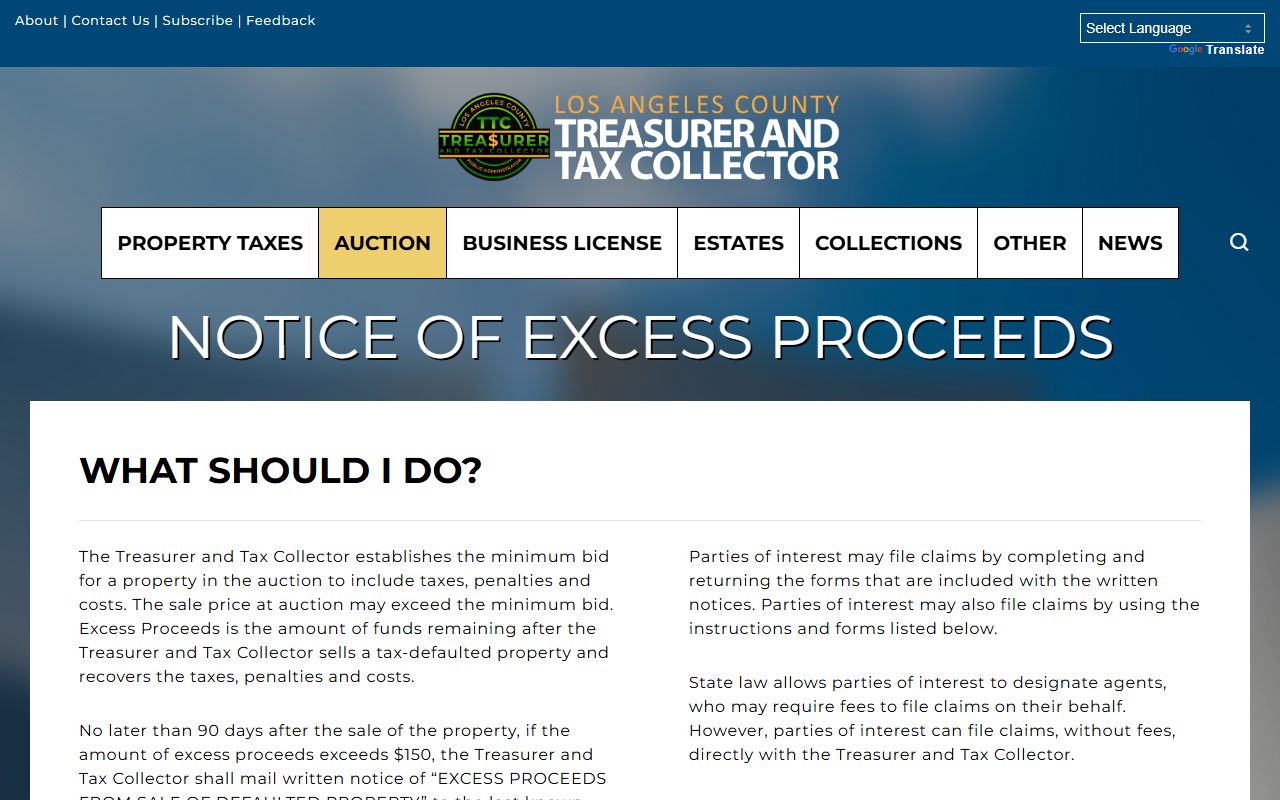
Excess proceeds is the amount of funds remaining after the treasurer and tax collector sells a tax-defaulted property. If the sale price exceeds the amount owed for taxes, penalties, and costs, the extra money is held in trust. This happens fairly often in Los Angeles County where property values are high. Even a small parcel can sell for much more than the tax debt.
The county also holds other types of unclaimed funds. These can include uncashed checks issued by county departments, deposits from contractors, and refunds that were never claimed. Under Government Code sections 50050 to 50057, local agencies in California must hold unclaimed money for three years before it can escheat to the county general fund. Los Angeles County follows this process and publishes annual notices of unclaimed funds.
Note: Contact the Los Angeles County Treasurer main phone at (213) 974-2111 for questions about county-held unclaimed property.
California State Controller Unclaimed Property
Most unclaimed money in Los Angeles County ends up with the California State Controller. Banks, insurance companies, employers, and other businesses must report unclaimed property to the state. This includes bank accounts, paychecks, security deposits, insurance payouts, and stocks. The state holds over $11 billion in unclaimed property waiting for owners to claim it. Millions of Los Angeles County residents have money waiting at the state controller.
You can search for your unclaimed property at the state controller's property search database. The search is free and takes just a few minutes. Enter your name or business name to see if the state is holding property for you. The database shows the property type, the reporting business, and the approximate amount. If you find property that belongs to you, you can file a claim online in many cases.
California law sets different dormancy periods for different types of property. Bank accounts become unclaimed after three years of no activity. Wages or paychecks are reportable after just one year. Money orders must be held for seven years, and traveler's checks for fifteen years. These rules are spelled out in Code of Civil Procedure section 1513. Once property is turned over to the state, there is no time limit for filing a claim. You can claim property turned in decades ago if you can prove ownership.
The state controller processes claims for free. You do not need to hire a company or pay a fee. If you receive a letter from an asset locator or heir finder, know that they can charge up to 10 percent of the property value. You can skip the middleman and file your own claim at no cost. The controller decides claims within 180 days in most cases. Simple cash claims take 30 to 60 days. More complex claims involving heirs, businesses, or securities can take up to 180 days or longer.
How to Claim Unclaimed Money
The claim process depends on where the property is held. For state-held property, start by searching the California State Controller's unclaimed property website. When you find property in your name, click on it to start a claim. The site will tell you if you can file online or if you need to submit a paper claim. Many claims can be filed electronically, which speeds up the process.
You need to prove you are the rightful owner. The type of proof depends on the property and the amount. For claims under $1,000, you may only need to provide your name, address, and Social Security number. Claims over $1,000 require notarization. If you are claiming on behalf of a deceased person, you need to provide a death certificate and proof that you are the legal heir. Business claims require articles of incorporation or other business documents.
Forms you may need include:
- Claim Affirmation Form (generated from search results)
- Declaration Under Probate Code 13101 (for estates under $166,250)
- Table of Heirship (for claims by heirs)
- Safe Deposit Box Property Release Form (for box contents)
Mail completed paper claims to Chief, Unclaimed Property Division, P.O. Box 942850, Sacramento, CA 94250-5873. You can also drop off claims in person at the public counter located at 10600 White Rock Road, Suite 141, Rancho Cordova, CA 95670. The controller will review your claim and send you a check if approved. Property is removed from the public database while a claim is being processed.
For Los Angeles County excess proceeds, the process is different. You must file a claim directly with the county treasurer. Visit the excess proceeds page to see the list of properties and claim forms. The county has its own deadlines and requirements that differ from the state controller. Make sure you know which entity holds your property before you file a claim.
Types of Unclaimed Property in Los Angeles County
Unclaimed property takes many forms. The most common type is a forgotten bank account. Checking and savings accounts become unclaimed when there is no activity for three years and the bank cannot reach the owner. Los Angeles County has thousands of old bank accounts sitting with the state controller. Credit union accounts and certificates of deposit also end up as unclaimed property.
Uncashed paychecks are another big source. Employers must turn over paychecks after one year if they cannot locate the employee. This happens when someone moves without giving a forwarding address or when a final check gets lost in the mail. Los Angeles County, with its large and mobile population, generates a lot of unclaimed wages each year.
Insurance proceeds often go unclaimed. Life insurance policies pay out when the insured person dies, but beneficiaries may not know the policy exists. Health insurance overpayments, property insurance refunds, and auto insurance claim checks also become unclaimed. California law now requires insurers to check the Death Master File and try to locate beneficiaries, but many policies still slip through the cracks.
Other common types of unclaimed property include:
- Stock dividends and mutual fund distributions
- Utility deposits and refunds
- Escrow accounts and earnest money
- Court deposits and settlements
- Royalties from oil, gas, or mineral rights
- Safe deposit box contents
- Matured savings bonds
Los Angeles County excess proceeds are a unique category. These funds come from the sale of tax-defaulted property. When the county auctions off a property to collect back taxes, the winning bid may exceed the tax debt. The leftover money goes to the former owner or any lien holders. Excess proceeds can be substantial in areas where property values have risen. A property bought years ago for a low price may now sell for tens of thousands more than the tax bill.
California Unclaimed Property Laws
California's unclaimed property system is governed by state law. The main statute is the Code of Civil Procedure sections 1500 through 1582, known as the Unclaimed Property Law. This law defines what property is subject to escheat and sets the rules for reporting and claiming it. The law applies statewide, including in Los Angeles County.
Holders of unclaimed property must file an annual report with the state controller. The report is due by November 1 for most businesses and by May 1 for life insurance companies. Holders must try to notify owners before turning property over to the state. Under section 1530, holders must send written notice to the owner's last known address at least six months before filing a report. If the property is worth $50 or more and the holder has an address, notice is required.
The state controller reviews claims and decides whether to pay them. According to section 1540, the controller must make a decision within 180 days of receiving a complete claim. No interest is paid on claims, even if the state held the property for many years. This means the value of your claim does not grow over time. Inflation can erode the purchasing power of old unclaimed funds.
Penalties apply to holders who fail to report or turn over property on time. Willful violations can result in misdemeanor charges under sections 1576 and 1577. Late delivery of property triggers a 12 percent annual interest penalty. These rules push businesses to comply with the law and protect the rights of property owners in Los Angeles County and across California.
County-level unclaimed property is subject to different rules. Government Code sections 50050 through 50057 govern unclaimed money held by cities, counties, and special districts. Local agencies must publish a notice of unclaimed funds once a year. If no one claims the money within three years of publication, it escheats to the local agency's general fund. This means Los Angeles County can eventually absorb unclaimed county funds into its budget, unlike state-held property which never escheats.
Contact Information for Claims
For California State Controller unclaimed property, call the toll-free number at (800) 992-4647. The call center is open during regular business hours. If you are calling from outside the United States, dial (916) 323-2827. You can also contact the controller through an online form on the state website.
Mail claims to Chief, Unclaimed Property Division, P.O. Box 942850, Sacramento, CA 94250-5873. For in-person visits or overnight mail, use the physical address at 10600 White Rock Road, Suite 141, Rancho Cordova, CA 95670. The public counter can answer questions and accept claim forms.
For Los Angeles County excess proceeds, contact the Treasurer and Tax Collector at (213) 974-2111. The main office is located in downtown Los Angeles. Visit the county website at ttc.lacounty.gov for more details on county programs and claim procedures.
Related Unclaimed Property Resources
Several other agencies in California hold unclaimed money that may belong to Los Angeles County residents. CalPERS manages unclaimed retirement benefits for public employees. If you worked for a California city, county, school district, or state agency, you may have unclaimed pension funds. Call (888) 225-7377 to search for benefits or file a claim.
CalSTRS holds unclaimed property for teachers and school employees. This includes retirement account balances that were never claimed. Reach CalSTRS at (800) 228-5453 if you worked in education and think you may have unclaimed funds.
The California Department of Insurance provides access to the national Life Insurance Policy Locator. This service helps you find life insurance policies and annuities when you do not know which company held the policy. The consumer hotline is (800) 927-4357.
If you are owed a tax refund, check with the California Franchise Tax Board. Refund checks are good for six months. If your check is older than that, you must request a replacement. Call (800) 852-5711 for help with old refund checks.
The California Employment Development Department handles unclaimed unemployment and disability benefits. If you had an uncashed check from EDD, you can file a claim using form DE 903SD. There is no fee to claim these funds. Call (800) 300-5616 for unemployment insurance or (800) 480-3287 for disability insurance.
For unpaid wages, the state Department of Industrial Relations runs an Unpaid Wage Fund. This fund holds money collected from employers who failed to pay workers. Call (833) 526-4636 to see if you have wages waiting. All of these programs operate separately from the state controller's unclaimed property division, so you need to check each one individually if you think you may have funds in Los Angeles County or anywhere in California.
Major Cities in Los Angeles County
Los Angeles County is the most populous county in the United States. It has 88 incorporated cities plus many unincorporated areas. Residents of any city in the county can have unclaimed money held by the state or county. Some larger cities also run their own unclaimed property programs separate from the county.
Other major cities in Los Angeles County include Torrance, Pomona, Lancaster, Palmdale, Downey, Inglewood, West Covina, Norwalk, and El Monte. All of these cities have residents with unclaimed property waiting to be claimed.
Nearby Counties
These counties border Los Angeles County. If you have lived or worked in multiple counties, you should search for unclaimed money in each location. The state controller database covers all of California, but county-held funds are managed locally.