
Glenn County Unclaimed Property Search
Glenn County maintains its own list of unclaimed funds that were issued and mailed by the county but remain outstanding after six months. These are checks from various county departments that never got cashed. The county Auditor-Controller publishes this list to help people find money they may not know about. You can also search the California State Controller database for other types of unclaimed property. The state holds billions in lost bank accounts, paychecks, insurance money, and more. Glenn County residents should check both sources. The county list covers local government checks. The state database includes property from businesses across California. Many people in Willows and other Glenn County communities have money waiting in one or both places. Finding it takes just a few minutes of searching online or making a phone call.
Glenn County Quick Facts
Glenn County Unclaimed Property Program
The County of Glenn Finance Department has compiled a list of all unclaimed funds issued by the county. These are checks that were mailed out but never cashed. After six months, a check becomes stale dated and is added to the unclaimed property list. The county publishes this list online so people can see if they have money waiting.
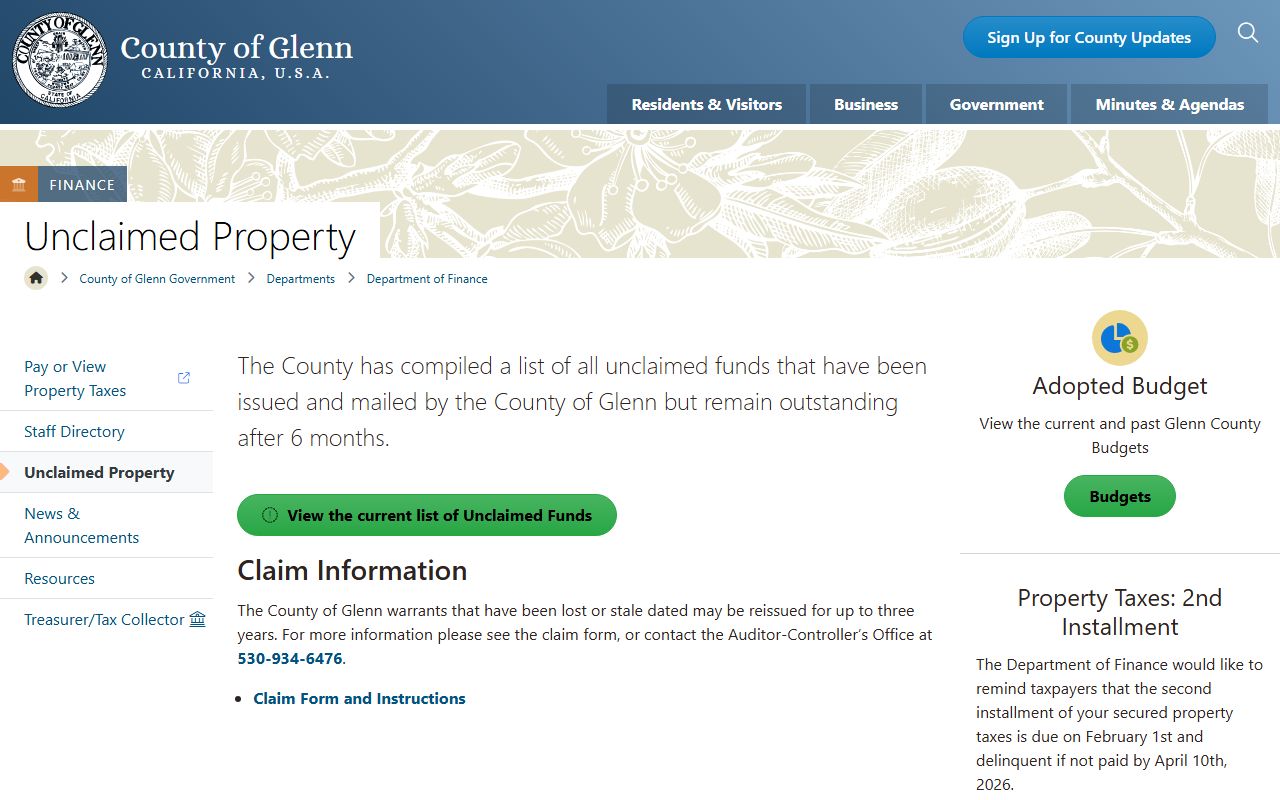
Common sources of Glenn County unclaimed checks include property tax refunds, vendor payments to contractors, employee reimbursements, and refunds for overpaid fees. If you did business with the county or owned property in Glenn County, you may have a check on the list. The county makes an effort to locate owners, but sometimes people move or the mail does not reach them. Checks sit unclaimed for years in some cases.
To claim a Glenn County check, call the Auditor-Controller at (530) 934-6476. Staff will ask you to identify yourself and verify you are the rightful owner. You may need to provide a driver's license, Social Security number, or other proof of identity. Once verified, the county will reissue the check. This process is free. You do not pay any fees to claim county-held funds.
Glenn County follows state law for local unclaimed property. Government Code sections 50050 through 50057 require counties to hold unclaimed money for three years. After three years, if no one claims it, the money can escheat to the county general fund. This means the county can use the funds for its budget. You have three years from the date the check was issued to claim it before it becomes county property. Check the county website regularly if you think you may have unclaimed funds.
California State Controller Unclaimed Property
Most unclaimed property in Glenn County ends up with the California State Controller. Banks, employers, insurance companies, and other businesses must report unclaimed property to the state after set dormancy periods. The state holds over $11 billion in lost property waiting for owners. Glenn County residents make up a small portion of that total, but many locals have funds sitting unclaimed. Search the state database at the unclaimed property search portal to see if you have money waiting.
The search is simple and free. Enter your name or business name. The database shows all matches. You see what type of property is held, which business reported it, and an approximate value. If you find property that looks like yours, click on it to start a claim. Many claims can be filed online. This speeds up the process compared to mailing in paper forms.
California law sets dormancy periods for different property types. Bank accounts become unclaimed after three years of no activity. Paychecks go to the state after one year. Money orders must be held for seven years before being reported. These rules are in Code of Civil Procedure section 1513. Once property reaches the state, there is no time limit for claiming it. Property from decades ago can still be claimed if you prove you own it.
Glenn County has a small population and an economy based on agriculture. Many residents work in farming, ranching, or related industries. Seasonal farm work can lead to unclaimed wages when workers move on to other jobs or locations. Small businesses may have uncashed checks from vendors or customers. Retirees who moved to Glenn County from other parts of California may have old accounts they forgot about. All of these situations create unclaimed property that sits with the state controller waiting to be claimed.
Note: The state controller processes claims for free and never charges any fees to claim your property.
How to Claim Your Unclaimed Money
For Glenn County checks, start by visiting the county unclaimed property page. Look through the list to see if your name appears. If you find a check, call the Auditor-Controller at (530) 934-6476. They will ask you questions to verify your identity. You may need to provide your address, Social Security number, and other details. Once verified, the county reissues the check and mails it to you. The process takes a few weeks in most cases.
For state controller claims, go to the main unclaimed property page and search for your name. When you find property that belongs to you, the website tells you how to file a claim. Some claims can be filed online through the website. Others require paper forms that you mail in. Online claims are faster because you upload documents electronically and track your claim status online.
You must prove you are the rightful owner. For small claims under $1,000, you may only need basic information like your name, address, and Social Security number. The state verifies your identity through databases. For claims over $1,000, you must sign the claim form in front of a notary public. Notarization helps prevent fraud on higher value claims.
If you are claiming money that belonged to someone who died, the requirements are stricter. You need a death certificate to show the person is deceased. You also need proof you are the legal heir. This could be a will that names you, a court order appointing you as executor, or a Declaration Under Probate Code 13101 for smaller estates. Business claims require proof the business is authorized to file the claim, such as articles of incorporation or a business license.
Common forms include:
- Claim Affirmation Form generated when you find property
- Declaration Under Probate Code 13101 for estates valued under $166,250
- Table of Heirship when multiple heirs are claiming
- Safe Deposit Box Property Release Form for box contents
Mail completed paper claims to Chief, Unclaimed Property Division, P.O. Box 942850, Sacramento, CA 94250-5873. For in-person visits, go to 10600 White Rock Road, Suite 141, Rancho Cordova, CA 95670. The controller reviews claims and sends a check if approved. Simple claims take 30 to 60 days. Complex claims involving heirs or businesses can take up to 180 days. The state does not pay interest, so you get back the original amount that was turned in.
Types of Unclaimed Property
Bank accounts are the most common type. Checking and savings accounts become unclaimed when there is no activity for three years and the bank cannot locate you. Glenn County residents who moved away or changed banks may have old accounts sitting unclaimed. Even small balances get turned over to the state. Credit union accounts and certificates of deposit also become unclaimed property.
Paychecks go unclaimed when employers cannot reach former employees. Final paychecks are especially common. Someone leaves a job and the last check gets sent to an old address. The employer holds it for a year then reports it to the state. Glenn County's agricultural economy means many people work seasonal jobs. When the season ends, workers move on and may never get their final pay.
Insurance proceeds often go unclaimed. Life insurance pays out when someone dies, but beneficiaries may not know a policy exists. The insurance company tries to find them but eventually turns the money over to the state. Health insurance overpayments, auto insurance refunds, and homeowner insurance claim checks also get reported as unclaimed. If you had insurance policies over the years and changed companies or let coverage lapse, you may have refunds waiting.
Other types of unclaimed property include:
- Stock dividends and mutual fund distributions
- Utility deposits from electric, gas, water, or phone companies
- Escrow refunds from home purchases or refinances
- Court deposits, settlements, and jury fees
- Safe deposit box contents when accounts are closed
- Royalties from oil, gas, mineral, or timber rights
- Uncashed money orders and cashier's checks
Glenn County checks are unique to the county. These include vendor payments for work done for the county, property tax refunds from successful appeals, reimbursements to county employees, and refunds for overpaid permit fees or deposits. Anyone who did business with Glenn County or owned property here should check the county list. These checks do not appear in the state database because they are held locally by the county.
California Unclaimed Money Laws
State unclaimed property law is found in the Code of Civil Procedure sections 1500 through 1582. These statutes govern how businesses handle unclaimed property. Banks, insurance companies, employers, utilities, and other businesses must follow these rules. Any business operating in Glenn County that holds unclaimed property must report it to the state controller.
Businesses file annual reports. Most file by November 1 each year. Life insurance companies file by May 1. Before reporting property, businesses must try to contact the owner. Section 1530 requires written notice to the owner's last known address. The notice must go out at least six months before the business files its report. If property is worth $50 or more and the business has an address, sending notice is mandatory. Many owners receive these notices and claim their property before it goes to the state.
The state controller decides whether to approve claims. According to section 1540, the controller must decide within 180 days of receiving a complete claim. Incomplete claims take longer because the claimant must provide missing documents. The state does not pay interest on unclaimed property. A bank account that earned interest before being turned over will not continue to grow. You receive the amount the bank reported and nothing more.
Penalties apply to businesses that fail to comply. Willful violations can be prosecuted as misdemeanors under sections 1576 and 1577. Late delivery of property triggers a 12 percent annual interest penalty. These rules push businesses to comply with the law and protect property owners in Glenn County and across California.
County unclaimed property follows different rules. Government Code sections 50050 through 50057 apply to local agencies. Counties must publish annual notices of unclaimed funds. If no one claims the money within three years, it escheats to the county general fund. This differs from state-held property which never escheats. Glenn County can absorb unclaimed county checks into its budget after the three year waiting period expires.
Contact Information for Claims
For Glenn County unclaimed property, call the Auditor-Controller at (530) 934-6476. This office handles questions about county checks and the unclaimed property list. You can also visit the Glenn County website at countyofglenn.net for more information about county departments and services. The county seat is in Willows where most county offices are located.
For California State Controller unclaimed property, call the toll-free number (800) 992-4647. This number works from anywhere in the United States. If calling from outside the US, dial (916) 323-2827. The call center operates during regular business hours and can answer questions about searching and claiming. You can also contact the controller through an online form on the state website.
Mail state claims to Chief, Unclaimed Property Division, P.O. Box 942850, Sacramento, CA 94250-5873. For in-person visits or overnight mail, use 10600 White Rock Road, Suite 141, Rancho Cordova, CA 95670. The public counter is open during business hours. Staff can answer questions and accept claim forms in person.
Other Unclaimed Property Resources
Several other agencies hold unclaimed money for Glenn County residents. CalPERS manages retirement benefits for California public employees. If you worked for a government agency, school district, or other public employer, you may have unclaimed pension funds. Call (888) 225-7377 to search CalPERS records or file a claim.
CalSTRS holds unclaimed property for teachers and school employees. If you worked in education and left teaching without claiming your retirement account, CalSTRS may be holding it. Call (800) 228-5453 to inquire about CalSTRS unclaimed property.
The California Department of Insurance provides access to a national life insurance policy locator. This service helps you find policies when you do not know which company issued them. The consumer hotline is (800) 927-4357 for questions about insurance and unclaimed benefits.
Check the California Franchise Tax Board for old tax refunds. State tax refund checks are good for six months. After that, you must request a replacement. Call (800) 852-5711 for help with unclaimed or expired tax refunds.
The California Employment Development Department handles unclaimed unemployment and disability insurance benefits. File a claim using form DE 903SD. There is no fee to claim these funds. Call (800) 300-5616 for unemployment insurance or (800) 480-3287 for disability insurance. Each of these programs operates separately from the state controller and county systems, so check them individually if you think you have unclaimed money in Glenn County or anywhere in California.
Nearby Counties
These counties border Glenn County. If you lived or worked in multiple counties, search for unclaimed money in each location. The state controller database covers all of California, but county programs operate separately.