
Yolo County Unclaimed Property Search
Yolo County unclaimed money programs include both county-held checks and state controller property. The Yolo County Financial Services Division maintains records of unclaimed property checks issued by the county. These include vendor payments, refunds, and other county checks that were never cashed. Beyond county programs, most unclaimed property from Yolo County residents is held by the California State Controller. Banks, employers, insurance companies, and other businesses report unclaimed property to the state after legal dormancy periods expire. You can search both the county system and state database to locate money that belongs to you. The search and claim process is completely free with no fees charged at any stage.
Yolo County Quick Facts
Yolo County Unclaimed Property Checks
The Yolo County Financial Services Division manages unclaimed property checks. These are checks issued by county departments that were never cashed. Common examples include vendor payments, contractor refunds, permit refunds, and other payments made by the county that the recipient never collected.
Unclaimed county checks accumulate for various reasons. A vendor moves and the check goes to an old address. A contractor forgets to cash a refund check. Someone receives a permit refund but misplaces the check. The county holds these uncashed checks and publishes information to help recipients find and claim them.
Contact Yolo County Financial Services by email at generalaccounting@yolocounty.gov for information about unclaimed checks. The staff can search county records to see if they are holding checks in your name. They will provide claim forms and explain the documentation required. There is no fee to claim county-held checks.
Yolo County follows Government Code sections 50050 to 50057 when handling unclaimed property. These laws require local agencies to hold unclaimed money for three years before it can escheat to the county general fund. The county must publish a notice giving potential claimants an opportunity to come forward. Even after escheatment, rightful owners can still file claims.
Common types of county-held unclaimed checks include:
- Vendor payments for goods or services
- Contractor deposits and refunds
- Permit fee refunds
- Overpayment refunds from various county departments
- Employee final paychecks that could not be delivered
California State Controller Property
Most unclaimed money from Yolo County ends up with the California State Controller. The state holds over $11 billion in unclaimed property. Yolo County, with its mix of agricultural areas, college towns, and suburban communities, generates significant unclaimed property each year. Banks, employers, and insurance companies turn over dormant accounts and uncashed checks to the state.
Search for your property at the state controller's online search portal. The database is free to search and operates 24 hours a day. Enter your name to see all property reported in your name. The search results display the property type, the business that reported it, and an approximate value.
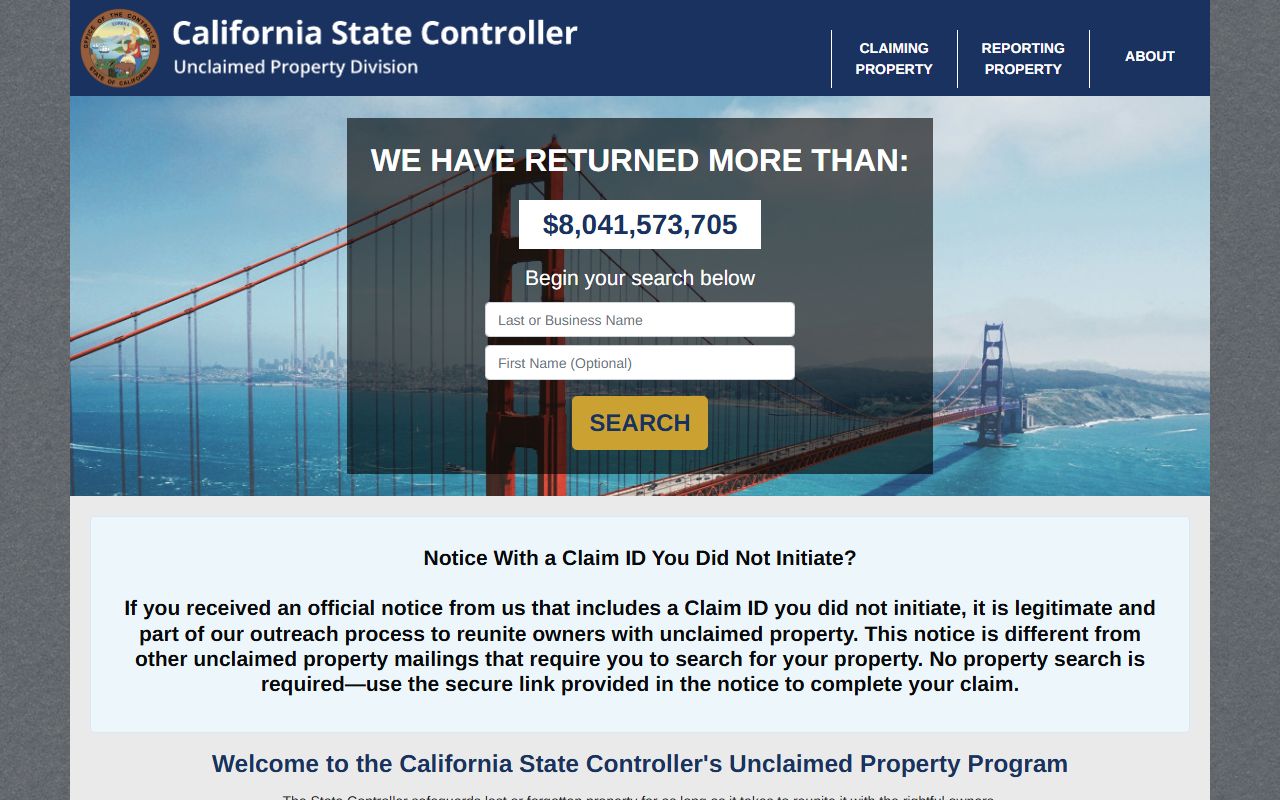
Search thoroughly using every name variation. Try your full legal name and any nicknames you use. Search maiden names if you married or divorced. Include business names if you owned a company in Yolo County. Try addresses where you lived in cities like Davis, Woodland, or West Sacramento. Many residents find multiple pieces of property by searching different ways.
When you find property that belongs to you, click on it to view details and start the claim process. The website tells you if you can file online or need to submit a paper claim. Online claims are faster and more convenient. The system generates a claim form with the property information already filled in. You add your current contact details and submit it electronically.
Simple claims under $1,000 often require just basic identification. The state verifies your identity and processes the claim. Claims over $1,000 must be notarized. You sign the form in front of a notary public who verifies your identity. All securities claims require notarization no matter the value. Safe deposit box claims have additional requirements because contents may include valuables beyond cash.
Filing a Claim
Start by determining where your property is held. County checks are with Yolo County Financial Services. Most other unclaimed property is with the state controller. Search both databases to find all money owed to you.
For Yolo County checks, email generalaccounting@yolocounty.gov and ask if they have unclaimed checks in your name. Include your full name and any previous addresses in Yolo County. The county will check their records and respond with information about any unclaimed checks. If they find checks owed to you, they will send claim forms with instructions.
For state-held property, visit the California State Controller's unclaimed property website. Search your name thoroughly. Try current and previous names. Include addresses. When you find your property, follow the claim instructions provided by the website. Many claims can be completed entirely online.
Documents commonly needed for claims include:
- Photo ID such as driver's license or passport
- Social Security number or tax identification number
- Proof of current address like utility bill or bank statement
- Death certificate if claiming for a deceased owner
- Probate documents or small estate affidavit for estates
- Business formation documents for business property
- Marriage or divorce papers if name changed
Mail paper claims to Chief, Unclaimed Property Division, P.O. Box 942850, Sacramento, CA 94250-5873. Include all required documents. The controller sends an acknowledgment letter when they receive your claim. A decision letter follows when they approve or deny it. Approved claims result in a check mailed to your address.
Processing times vary. Simple cash claims take 30 to 60 days. Complex claims involving heirs, businesses, or securities can take up to 180 days or longer. The state removes property from the public database while processing your claim to prevent duplicate filings.
Note: Never pay anyone to search for or claim your unclaimed property when you can do it yourself for free.
Common Unclaimed Property Types
Bank accounts lead the list of unclaimed property. A checking or savings account sits unused for three years. The bank cannot reach you. They report the account to the state. Yolo County has thousands of forgotten bank accounts. College students who attended UC Davis often have small accounts they opened and forgot. People who moved between Davis, Woodland, and Sacramento lose track of accounts.
Paychecks go unclaimed regularly. An employer issues a final paycheck. The employee moved without updating their address. The check cannot be delivered. After one year, the employer sends the uncashed wages to the state. This happens frequently with students, seasonal workers, and temporary employees in Yolo County.
Insurance proceeds often go unclaimed. Life insurance pays out when someone dies but beneficiaries may not know the policy exists. Auto insurance issues refunds after policy cancellations. Health insurance overpays claims. All of these become unclaimed property if not collected within the dormancy period.
Utility deposits are common. You close an account with the electric company or water district. They owe you a deposit refund. The check goes to your old address. You moved without leaving forwarding information. One year later, the utility reports the unclaimed deposit to the state. These deposits range from $50 to several hundred dollars depending on usage history.
Additional types of unclaimed property include:
- Stock dividends and mutual fund distributions
- Rebates and refunds from retailers
- Escrow refunds from real estate deals
- Security deposits from rental properties (common in Davis)
- Agricultural payments and cooperative distributions
- Safe deposit box contents
- Court deposits and legal settlements
- Royalties from mineral or water rights
Yolo County's agricultural economy creates unique unclaimed property. Farm cooperative distributions, crop insurance payments, and agricultural vendor refunds all become unclaimed when owners cannot be located. Anyone involved in farming should search regularly for unclaimed agricultural payments.
Property Dormancy Periods
California law sets different dormancy periods for different types of property. These periods are defined in Code of Civil Procedure section 1513. Understanding these periods helps you know when to search for property that might have been reported.
Bank accounts become unclaimed after three years of no owner activity. No activity means no deposits, withdrawals, or contact with the bank. Even logging into online banking counts as activity and restarts the clock. After three years of complete inactivity, the bank must report the account to the state.
Wages have the shortest dormancy period at one year. An employer holding an uncashed paycheck must report it after one year. This protects workers who need their pay. UC Davis and other large employers in Yolo County report unclaimed wages annually.
Money orders have a seven-year dormancy period. Traveler's checks must be held for fifteen years. These longer periods recognize that people sometimes purchase these instruments and forget about them. The extended time gives owners more opportunity to use them before they become unclaimed.
Insurance proceeds follow special rules. Life insurance becomes reportable immediately after the insurer knows the insured person died. Other insurance types follow the standard three-year rule.
Other key dormancy periods include:
- Utility deposits: one year after account closure
- Stocks and dividends: three years from payment date
- Safe deposit boxes: three years after rent becomes overdue
- Court deposits: three years after final judgment
- Mineral proceeds: three years from date payable
Once property reaches the state controller, dormancy periods no longer matter. The state holds property indefinitely with no time limit for claiming. You can claim property reported decades ago if you prove ownership.
California Unclaimed Property Law
California's Unclaimed Property Law is codified in the Code of Civil Procedure. Section 1500 establishes the short title. Sections 1501 through 1577 contain all detailed provisions about reporting, holding, and claiming property.
Section 1501 defines critical terms. A holder is any person or business holding property that belongs to another. An owner is the person entitled to the property. An apparent owner is the person whose name appears on the holder's records. These definitions determine who must report property and who can claim it.
Section 1530 requires annual reporting by holders. Life insurance companies file reports between December 1 and December 15. All other businesses and entities report between June 1 and June 15. The report must list each piece of unclaimed property, identify the apparent owner, and show the last known address. Holders deliver the actual property to the state controller with the report.
The controller maintains a public database of all reported property. Section 1540 governs the claim process. Anyone can search the database and file claims. The controller has 180 days to decide each claim. The controller can request additional documentation to prove ownership. Approved claims result in payment. The state does not pay interest on unclaimed property.
Section 1576 sets penalties for violations. Willfully failing to report unclaimed property is a misdemeanor. Late delivery of property triggers a 12 percent annual interest penalty from the date it should have been delivered. These penalties encourage businesses to comply with reporting requirements.
Local government agencies like Yolo County follow Government Code sections 50050 to 50057. These sections govern unclaimed money held by counties, cities, and special districts. The rules are similar but adapted for public agencies rather than private businesses.
Contact Information
For Yolo County unclaimed property checks, email generalaccounting@yolocounty.gov. The Financial Services Division can search county records for unclaimed checks in your name. They will provide claim forms if they find checks owed to you. There is no charge to file a claim with the county.
For all other unclaimed property, contact the California State Controller's Unclaimed Property Division. The toll-free number is (800) 992-4647. This line works from anywhere in the United States. International callers can dial (916) 323-2827. The call center operates during business hours Pacific time.
Visit the state controller's public counter at 10600 White Rock Road, Suite 141, Rancho Cordova, CA 95670. This office is close to Yolo County and serves walk-in customers. Staff can help you search and file claims in person. Bring photo identification and any documents related to your property. Call ahead to confirm hours before visiting.
Mail all paper claim forms and supporting documents to Chief, Unclaimed Property Division, P.O. Box 942850, Sacramento, CA 94250-5873. This is the official mailing address for state controller claims. The controller sends acknowledgment letters when they receive claims and decision letters when they approve or deny them.
Submit general questions through the online form on the state controller's website. Most questions receive responses within a few business days. Email works for general inquiries but should not be used to send claim forms or sensitive personal information.
Major Cities in Yolo County
Yolo County includes several cities that may maintain their own local unclaimed money programs. Davis, with its large university population, generates unclaimed property from students and temporary residents. West Sacramento borders Sacramento County and has robust city services. Woodland serves as the county seat.
Check with your city government to see if they maintain an unclaimed property program. Some cities publish annual notices of unclaimed funds. Even if your city does not have an online database, they can check their records if you contact them directly.
Always search the state controller database in addition to any local databases. Most unclaimed property ends up with the state rather than local governments. Banks, employers, and insurance companies report directly to the state controller, not to cities or counties.