
Trinity County Unclaimed Property
Trinity County unclaimed money includes excess proceeds from property tax sales and various funds held by the California State Controller. When Trinity County sells property for unpaid taxes, any amount remaining after paying the tax debt becomes excess proceeds. The county holds these funds for rightful claimants. Beyond local funds, most unclaimed property from Trinity County ends up with the state. Banks, employers, and insurance companies turn over dormant accounts and uncashed checks to the state controller after the legal dormancy period. You can search both county records and the state database to find money that may be yours. No fees apply to searching or claiming.
Trinity County Quick Facts
Trinity County Excess Proceeds
Trinity County holds excess proceeds from tax-defaulted property sales. When the county auctions a property to collect unpaid property taxes, the sale price often exceeds the tax debt. The extra money becomes excess proceeds. The county treasurer holds these funds in trust for parties with an interest in the property.
Former property owners have the first right to claim excess proceeds. If the owner does not claim the funds, lien holders can file claims. This includes mortgage companies, contractors with mechanics liens, and other creditors who recorded liens against the property. The county publishes notices after each tax sale to inform potential claimants.
You can contact Trinity County by email at taxcollector@trinitycounty.org for information about excess proceeds. The tax collector's office maintains records of all tax sales and available funds. They can tell you if excess proceeds exist from a property you once owned or held a lien against.
Filing a claim for excess proceeds requires proof of your interest in the property. Former owners need to show they held title at the time of the tax sale. Deed copies and property tax records serve as proof. Lien holders must provide recorded lien documents showing their claim was filed before the sale.
Trinity County follows Government Code sections 50050 to 50057 when handling excess proceeds and other unclaimed funds. The county must hold the money for at least three years before it can escheat to the county general fund. But even after escheatment, rightful owners can still file claims.
State Controller Unclaimed Property Database
Most unclaimed money from Trinity County residents sits with the California State Controller. Over $11 billion in total unclaimed property is held by the state. Trinity County accounts for a small but meaningful portion. Rural counties like Trinity often have higher rates of unclaimed property per capita because residents move frequently and businesses struggle to maintain current addresses.
Search the state database at the controller's online property search. The search tool is free and available 24 hours a day. Type your name to see all property reported to the state in your name. The results show the property type, reporting business, and estimated value.
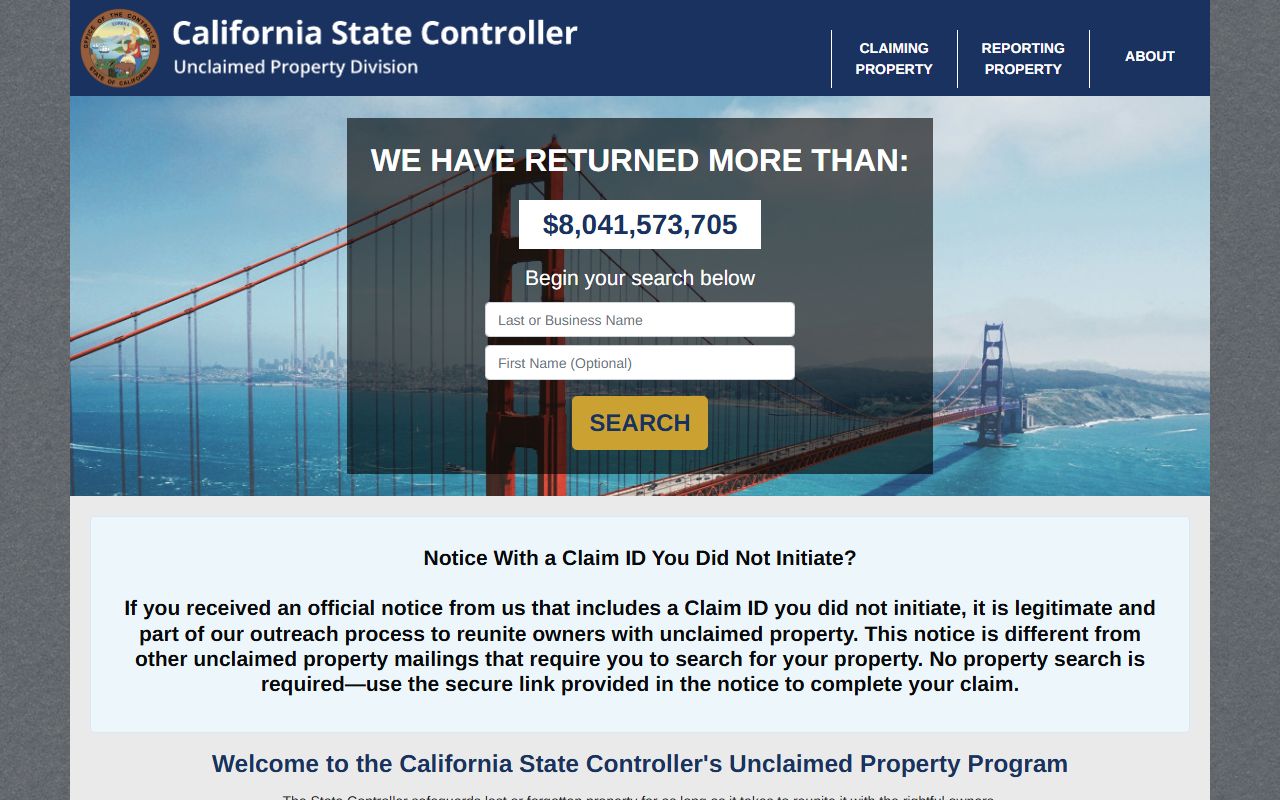
Try different name variations. Use your full legal name, nicknames, and any previous names. Search maiden names for women who married. Include middle initials and see if dropping the initial changes results. Many people find property they forgot about by trying multiple search terms.
Click on any property that looks like it belongs to you. The system shows more details and starts the claim process. You can file many claims online. The website generates a claim form pre-filled with the property information. You add your current contact details and submit the form electronically. Simple claims under $1,000 often require nothing more.
Larger claims need additional proof. Claims over $1,000 must be notarized. You sign the claim form in front of a notary public who verifies your identity. All securities claims require notarization regardless of value. Safe deposit box contents have special handling because they may include jewelry, coins, or other valuables beyond simple cash.
Common Unclaimed Property Types
Bank accounts are the most common unclaimed property. A checking or savings account sits unused for three years. The bank tries to contact you but the mail comes back. They report the account to the state. This happens often in Trinity County where people move between rural areas and cities, losing track of small accounts.
Paychecks go unclaimed regularly. An employer issues a final paycheck. The employee moved and left no forwarding address. The check cannot be delivered. After one year, the employer sends the money to the state. Seasonal work and temporary jobs in Trinity County create many unclaimed wage situations.
Utility deposits add up. You close an electric, gas, or water account. The utility owes you a deposit refund. They mail a check to your last known address. You already moved. One year later, the utility reports the unclaimed deposit to the state. These deposits range from $50 to several hundred dollars.
Insurance proceeds often go unclaimed in rural areas. Life insurance pays out when someone dies but the beneficiary never knew the policy existed. Auto insurance issues refunds after policy cancellations. Health insurance overpays claims. All of these become unclaimed property if not collected within the dormancy period.
Additional types you might find:
- Stock dividends from old investments
- Royalties from timber sales or mineral rights
- Escrow refunds from cancelled real estate transactions
- Security deposits from rental properties
- Rebates and refunds from retailers
- Contents of abandoned safe deposit boxes
- Court deposits and settlements
Note: Even small amounts are worth claiming because they never expire and the state holds them indefinitely.
Steps to Claim Your Property
Start your search at the California State Controller's unclaimed property page. This is the official government site. Avoid third-party websites that claim to help you find unclaimed money. Those sites often charge fees or collect your personal information.
Search thoroughly using every name you have used. Include addresses where you lived in Trinity County. The database indexes property by owner name and last known address. Searching both helps you find everything.
When you locate property, follow the claim instructions provided. Online claims are faster than paper claims. Create an account on the state controller's website if filing online. Verify your email address and log in to submit the claim form. Upload required documents if the system asks for them.
Paper claims work too. Print the claim form from the search results. Fill out every section completely. Sign and date the form. Get it notarized if the amount exceeds $1,000. Gather supporting documents like photo ID, Social Security card, or proof of address. Mail everything together to the address shown on the claim form.
Required documents vary by situation:
- Photo ID for all claims
- Social Security number or tax ID
- Proof of current address like a utility bill
- Death certificate when claiming for deceased persons
- Probate documents or small estate affidavit for estates
- Business formation papers for business claims
- Power of attorney if claiming for someone else
The state controller reviews your claim within 180 days. Simple claims take 30 to 60 days. Complex claims involving heirs or businesses can take the full 180 days or longer. You receive a letter when the claim is approved. The state mails a check to the address you provided on the claim form.
If your claim is denied, the letter explains why. Common reasons include insufficient proof of identity or ownership. You can submit additional documents and refile. There is no limit on how many times you can try.
Understanding Dormancy Periods
California law sets specific dormancy periods for different property types. These periods determine when a holder must report property to the state. Code of Civil Procedure section 1513 lays out the rules.
Bank accounts become unclaimed after three years of no activity. No activity means no deposits, withdrawals, or contact with the bank. Even logging into online banking counts as activity and restarts the three-year clock. Banks must try to contact you before reporting the account. If they cannot reach you, the account goes to the state.
Wages and paychecks have a one-year dormancy period. An employer holding an uncashed check for one year must report it to the state. This short period reflects the fact that paychecks are immediately due to employees. Waiting longer would be unfair to workers who may desperately need the money.
Money orders must be held for seven years before becoming unclaimed. Traveler's checks have a fifteen-year dormancy period. These longer periods recognize that people sometimes buy money orders or traveler's checks and then forget about them for years.
Other specific dormancy periods include:
- Insurance proceeds: immediately upon knowledge of death (life insurance) or three years (other types)
- Utility deposits: one year after account closure
- Stocks and dividends: three years from payment date
- Safe deposit box contents: three years after rent becomes overdue
- Court deposits: three years after final judgment or dismissal
Once property reaches the state controller, the dormancy period becomes irrelevant. The state holds the property forever. No statute of limitations applies. You can claim property reported in 1950 just as easily as property reported last year. This rule protects owners and ensures they never lose their right to claim.
California Unclaimed Property Law
The Unclaimed Property Law is codified in the California Code of Civil Procedure. Section 1500 provides the short title. Subsequent sections define terms, set dormancy periods, establish reporting requirements, and create the claim process.
Section 1501 defines key terms used throughout the law. A holder is anyone holding property belonging to another. An owner is the person entitled to the property. An apparent owner is the person named on the holder's records. These definitions matter when disputes arise about who can claim property.
Section 1530 requires holders to file annual reports. Life insurance companies report between December 1 and December 15. All other businesses report between June 1 and June 15. The report must list every piece of unclaimed property, identify the apparent owner, and provide the owner's last known address. Holders must deliver the property to the state controller along with the report.
The controller maintains a public database of all reported property. Section 1540 governs claims filed against the database. Anyone can search and file a claim. The controller has 180 days to approve or deny the claim. The controller can ask for additional proof before deciding. Approved claims result in payment to the claimant. No interest is paid on the property held by the state.
Section 1576 sets penalties for non-compliance. Willful failure to report unclaimed property is a misdemeanor. Late delivery of property to the state triggers a 12 percent annual interest penalty calculated from the date the property should have been delivered. These penalties encourage businesses to follow the law and turn over property on time.
Trinity County and State Contacts
For questions about Trinity County excess proceeds, contact the tax collector by email at taxcollector@trinitycounty.org. The tax collector's office is located in Weaverville, the county seat. They can provide information about tax sales, excess proceeds amounts, and claim procedures specific to the county.
For all other unclaimed property, contact the California State Controller's Unclaimed Property Division. Call toll-free at (800) 992-4647 from anywhere in the United States. From outside the country, dial (916) 323-2827. The call center operates during business hours Pacific time.
You can visit the state controller's public counter at 10600 White Rock Road, Suite 141, Rancho Cordova, CA 95670. Staff can help you search the database and file claims in person. Bring photo identification and any documents related to the property you are claiming. Call ahead to confirm hours before making the trip from Trinity County.
Mail paper claim forms and supporting documents to Chief, Unclaimed Property Division, P.O. Box 942850, Sacramento, CA 94250-5873. Use this mailing address for all claim submissions. The controller will acknowledge receipt and notify you of the decision by mail.
Online inquiries can be submitted through the contact form on the state controller's website. Most questions receive responses within a few business days. Email is good for general questions but not for submitting claims or sensitive documents.
Watch Out for Scams
Scammers prey on people looking for unclaimed money. You might get a letter saying you have thousands of dollars waiting. The letter asks for personal information or an upfront fee. This is a scam. The real state controller never charges fees to file claims and never asks for sensitive data through unsolicited mail.
Asset locators are legal but often not needed. These companies search databases and contact people who have unclaimed property. They offer to file your claim in exchange for a percentage of the property value. California law caps their fee at 10 percent. You can cancel the contract within 24 hours at no cost.
Before hiring an asset locator, try searching yourself. The state database is easy to use. The claim process is straightforward for most situations. Why pay 10 percent when you can do it yourself for free? Only consider hiring help if you face a complex estate issue or lack the time to handle it yourself.
Red flags that signal a scam:
- Requests for money before you receive your property
- High-pressure tactics demanding immediate action
- Emails or phone calls asking for your Social Security number
- Claims about large inheritances from unknown relatives
- Links to websites other than sco.ca.gov
- Promises that seem too good to be true
Always verify suspicious communications. Call the state controller directly using the number from their official website. Do not use contact information provided in the suspicious message. Type website addresses yourself instead of clicking links in emails. When in doubt, ask questions before sharing any personal information.
Report scam attempts to the state controller's office. They track fraud schemes and warn the public. Your report might prevent someone else from falling victim.